

Game System Architecture
The Games section at Goa Games is structured as a multi-layer environment rather than a flat list of titles. What appears on the surface as different categories — Roulette, Blackjack, Poker, Bingo, Live Casino, and Aviator — is in fact a combination of fundamentally different systems operating under a unified interface. The key to understanding this section is recognizing that not all games follow the same execution model. Some are driven by RNG-based engines, while others operate in real time with human interaction or server-synchronized events. Treating them as identical would create confusion, especially when explaining how outcomes are produced.
At the platform level, everything begins with the session layer. This layer handles account state, balance, bet validation, and access control. It ensures that when a player enters any game — whether it is a digital Blackjack table or a live Roulette stream — the environment is correctly initialized and aligned with the current session conditions. However, just as in slots, this layer does not influence outcomes. Its role is operational, not mathematical. The distinction remains consistent across all game types, even when the underlying mechanics differ significantly.
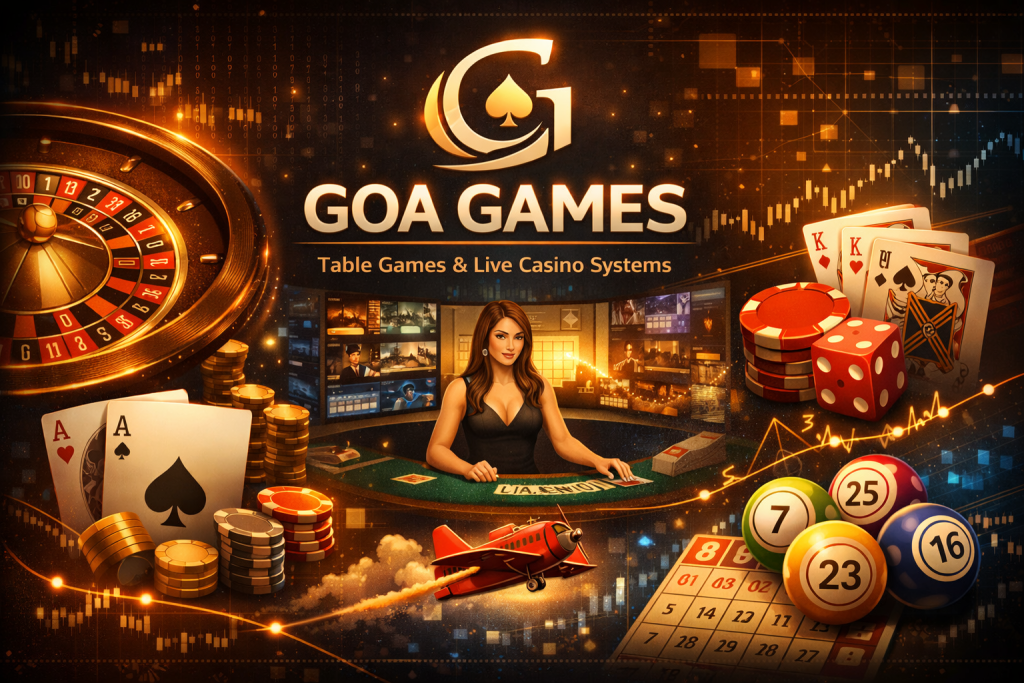
RNG-based games such as digital Roulette, Blackjack, Poker variants, Bingo draws, and Aviator rely on algorithmic outcome generation. In these cases, the system uses certified random number generation to produce results that are statistically independent. Each event — a spin, a card draw, or a multiplier crash — is calculated without memory of previous rounds. There is no adaptive behaviour, no pattern correction, and no dependency on player actions outside of the immediate bet. This keeps the system consistent and predictable at the model level, even though individual outcomes remain unpredictable.
Live Casino games introduce a different execution model. Instead of algorithmic generation, outcomes are determined by physical processes — a real dealer spinning a wheel, shuffling cards, or managing a table. The platform’s role shifts from generating outcomes to transmitting them. This includes video streaming, latency management, and synchronization between the live feed and player inputs. Despite this difference, the separation between session logic and outcome logic still holds. The platform does not alter the result; it only delivers it.
Aviator and similar instant-style games represent another category that often creates misunderstanding. Although visually dynamic and often perceived as reactive, these games still operate on predefined mathematical models. The multiplier progression and crash point are determined by the engine before or at the start of each round, depending on implementation. The player’s role is to decide when to exit, not to influence the outcome itself. This again reinforces the principle that interaction does not equate to control over results.
The value of structuring the Games section in this way is that it allows Goa Games to present different types of interaction without blending their logic. Players can move from a static RNG-based game to a live table or a timing-based mechanic like Aviator without misunderstanding how each system works. The platform does not need to oversimplify these differences; it can present them clearly as distinct models within a single environment.
Premium Table — Game Logic Matrix
Game Logic Matrix
Game Categories and Behaviour Models at Goa Games
The Games section at Goa Games becomes more useful when each category is framed by how it behaves rather than by how aggressively it is promoted. Roulette, Blackjack, Poker, Bingo, Live Casino, and Aviator are not interchangeable entertainment formats placed under one navigation label. They represent different interaction models, different pacing structures, and different relationships between player input and outcome resolution. A strong operator-style page should make those distinctions explicit because that is what helps a user understand the product surface without drifting into exaggerated or misleading language.
Roulette is one of the clearest examples of outcome separation from user intention. The player chooses a position in the betting layout, but the result itself is resolved by the wheel, whether digital or physical. In RNG roulette, the system generates the final number independently for each spin. In live roulette, the result comes from the physical wheel and ball interaction, transmitted through the platform. In both cases, the user is selecting exposure, not shaping the result. The category is defined by simplicity of decision structure and clarity of round resolution rather than by depth of progression. That makes Roulette highly readable, especially for users who prefer shorter decision cycles and immediate state changes.
Blackjack introduces a more layered form of decision-making because the player reacts to visible information inside a fixed rule set. Hit, stand, split, or double decisions create a different type of interaction rhythm from Roulette, even though the game remains structured and rule-bound. The important distinction is that decision depth should not be confused with outcome control. A player can influence the path of a hand through legitimate rule choices, but the card sequence itself is still determined by the underlying dealing model. In digital blackjack, that means RNG-based card delivery. In live blackjack, it means real-table dealing transmitted through the stream. Goa Games can present Blackjack as a higher-agency game in terms of decision flow, while still maintaining clarity about the limits of that agency.
Poker sits in a slightly different position because it can refer to multiple formats. In video poker, the player is dealing with a structured machine model where hold-and-draw decisions shape the final hand under a defined paytable. In multiplayer or casino-style poker variants, the tempo and context can change further, but the key point remains that Poker introduces a more analytical pacing style than purely round-resolved categories. It usually asks the player to process state rather than simply observe it. That gives Poker a more deliberate interaction profile, especially compared with fast-cycle categories such as Aviator or standard Roulette.
Bingo operates on a pooled draw model and should be described accordingly. It is often less about immediate tactical decision-making and more about synchronized participation in a shared draw event. The user enters the round structure, but the number draw itself remains independent of player behaviour. This makes Bingo feel socially adjacent or collectively paced even in digital form. It is not defined by intense control input but by timed participation, card structure, and draw anticipation. Goa Games can position Bingo as a lower-friction, draw-led category that offers a different tempo from card games or instant multiplier formats.
Live Casino changes the experience most clearly at the perception layer because it introduces a real-time human environment. The user is no longer interacting only with a digital interface but with a streamed table, a dealer presence, and synchronized round timing. This produces a stronger sense of immediacy and atmosphere, but the platform still remains a transmission layer rather than an outcome engine. That is an important distinction. Live Casino can feel more immersive, more social, and more operationally dynamic, yet its value should still be framed through interaction design and delivery quality, not through any implication that live format changes the fairness or return structure of the underlying game rules.
Aviator represents a different behavioural model altogether. It is round-based, visually compressed, and driven by timing decisions under a predefined round outcome structure. The multiplier rises until the round ends, and the user decides when to exit. This gives the game a strong sense of immediacy and reaction, but that should not be interpreted as user control over the crash event itself. The timing choice is real, but the result framework remains independently determined by the game model. From an operator perspective, Aviator is best described as a high-tempo interactive format with strong visual compression and rapid round cycling, not as a game of predictive mastery.
Taken together, these categories allow Goa Games to present a genuinely varied Games section without flattening everything into generic promotional language. Some users will prefer the fixed clarity of Roulette, others the decision structure of Blackjack or Poker, others the shared rhythm of Bingo, the atmosphere of Live Casino, or the compressed tempo of Aviator. None of these formats needs hype to feel distinct. Their structure already provides the differentiation.
Game Behaviour Architecture Map
Game Behaviour Architecture Map
This chart positions major game categories by interaction intensity and outcome delivery model. It is a structural product map, not a promise model and not a financial performance graph.
Moving right means the category feels more real-time, reactive, or synchronised in how results are delivered. Moving upward means the user is engaging with deeper visible decision structure. Neither direction implies a better result model. The chart describes interaction architecture only.
A stronger sense of control or immersion should not be read as stronger influence over outcomes. Goa Games can describe categories by decision depth and delivery style without implying edge, prediction, or improved returns.
Live Casino vs RNG Systems (Operational vs Real-Time Models)
At Goa Games, the distinction between RNG-based games and Live Casino is not cosmetic — it reflects two fundamentally different execution models that coexist within the same interface. Understanding this difference allows the platform to present both categories clearly without blending their mechanics or implying that one modifies the behaviour of the other. The separation remains consistent with the broader system logic: the session layer manages access and state, while the outcome layer operates independently according to its own rules.
RNG-based games — including digital Roulette, Blackjack, Poker variants, Bingo draws, and Aviator — rely on algorithmic outcome generation. In these systems, each round is calculated using a random number generator that produces statistically independent results. There is no carryover from previous rounds, no session-based adjustment, and no dependency on user behaviour outside the immediate bet. This creates a closed mathematical loop where the player interacts with a predefined model. The system does not respond to patterns, and it does not attempt to balance outcomes over time.
Live Casino introduces a different structure. Instead of generating results internally, the platform connects the player to a real-time environment where outcomes are determined externally — by a physical roulette wheel, a dealer’s card handling, or other real-world processes. Goa Games does not calculate these results; it receives and transmits them. The complexity shifts from mathematics to delivery. Video streaming, latency control, synchronization between player input and game state, and interface responsiveness become the key operational components. The result is not “more random” or “more fair” — it is simply produced through a different mechanism.
Latency plays a practical role in shaping the experience. In RNG systems, the result is immediate because it is computed locally within the game engine. In Live Casino, there is a slight delay introduced by video transmission and synchronization windows. This delay does not affect the outcome itself, but it changes how the player perceives the interaction. Decisions must be made within defined time windows, and the system must ensure that all participants are aligned with the same game state. Goa Games manages this through controlled timing phases rather than altering results.
Another important difference is interaction structure. RNG games are typically asynchronous — the player can engage at their own pace, with each round independent of other users. Live Casino is synchronous. Players share the same round, observe the same dealer actions, and resolve outcomes simultaneously. This creates a stronger sense of shared environment, but it also imposes timing constraints that do not exist in standalone digital games. Again, this is an interaction difference, not a mathematical one.
From an operator perspective, the correct framing is to describe these systems in terms of delivery and interaction rather than perceived advantage. RNG games offer speed, autonomy, and consistent pacing. Live Casino offers real-time presence, shared rounds, and visual continuity. Neither system changes RTP logic or introduces predictive elements. Both operate within clearly defined rules, and both maintain the separation between platform control and outcome generation.
RNG vs Live System Flow
RNG vs Live System Behaviour
UX, Mobile Interaction and Session Continuity (Games Section)
The Games section at Goa Games is designed as a navigation system first and a content layer second. That distinction matters because the value of the page is not only in listing categories like Roulette, Blackjack, Poker, Bingo, Live Casino, and Aviator, but in how efficiently a player can move between them without losing context. The interface avoids aggressive visual prioritisation or forced pathways. Instead, it relies on structural clarity — categories are stable, transitions are predictable, and session state remains consistent across interactions. This creates an environment where exploration feels controlled rather than guided.
Session continuity is maintained at the platform level and applies uniformly across all game types. When a player switches from a digital Blackjack table to a Live Casino stream or opens an Aviator round after browsing Bingo, the system preserves balance state, active bonus conditions, and access permissions. However, this continuity should not be misinterpreted as continuity of outcomes. Each game instance — whether RNG-based or live — resolves independently. The platform restores the environment, not the result trajectory. This is an important distinction because it prevents the interface from implying that switching games or returning to a previous title affects future outcomes.
From a UX perspective, interaction speed is a core priority. The Games section is structured to reduce time between intent and action. Recently played entries, category grouping, and direct launch behaviour all contribute to minimizing navigation friction. On desktop, this is expressed through stable layouts and clear grouping. On mobile, it becomes more critical. Touch interfaces require larger hit areas, simplified hierarchies, and vertical stacking that preserves readability without forcing horizontal scrolling. Goa Games addresses this by converting complex layouts into card-based structures where necessary, ensuring that interaction remains fluid even on smaller screens.
Another important layer is information density. Different game categories inherently carry different levels of complexity, but the surrounding interface should not amplify that complexity unnecessarily. A Live Casino tile, a Blackjack entry, and an Aviator launch point should all present consistent structural cues — title, state, and access — without overloading the user with secondary data. This allows the player to make quick decisions without misinterpreting visual intensity as functional difference. The interface becomes a neutral frame rather than a competing signal.
Mobile behaviour also affects how interactive elements respond. Hover states are replaced by tap interactions, and any contextual information — such as tooltips or system notes — must be accessible without relying on cursor behaviour. This requires reposition logic and touch-safe activation, especially for components like graphs or expandable elements. Goa Games maintains this by ensuring that all interactive modules adapt to touch input without breaking layout or hiding critical information.
Ultimately, the Games section functions as a controlled environment where structure, not persuasion, drives engagement. The platform provides access to multiple game systems, each with its own logic, but presents them through a consistent interface that does not distort their underlying behaviour. This is what allows the page to remain aligned with an operator-level approach: it supports user understanding rather than attempting to influence user perception.
Game UX & Session Behaviour Matrix
Game UX & Session Behaviour Matrix
| Component | Function | Impact on Gameplay |
|---|---|---|
| Session Continuity | Maintains balance and active game access across categories. | None — outcomes remain independent. |
| Mobile Adaptation | Transforms layout into touch-friendly card structure. | None — usability only. |
| Quick Navigation | Reduces time between category selection and gameplay. | None — interaction efficiency. |
| Live Synchronization | Aligns player input with real-time dealer events. | None — does not affect results. |





Comments